
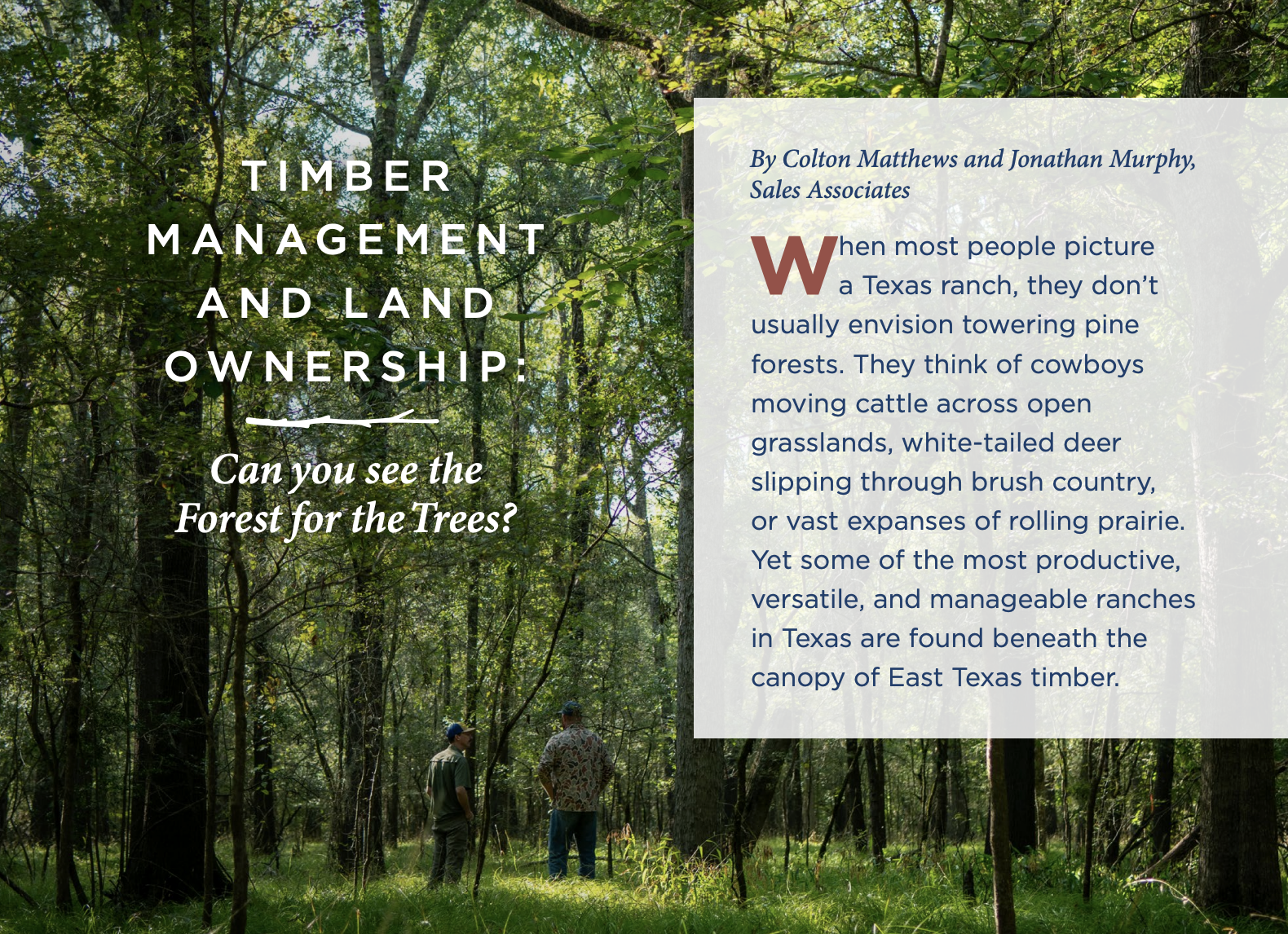
Can you see the Forest for the Trees?
By Colton Matthews and Jonathan Murphy, Sales Associates, Featured in the Republic Report Q2 2026
When most people picture a Texas ranch, they don’t usually envision towering pine forests. They think of cowboys moving cattle across open grasslands, white-tailed deer slipping through brush country, or vast expanses of rolling prairie. Yet some of the most productive, versatile, and manageable ranches in Texas are found beneath the canopy of East Texas timber.
The Pineywoods region contains one of the largest concentrations of timberland in the United States. East Texas alone supports approximately 12 million acres of timberland, with pine forests representing the dominant forest type across the region (Texas A&M Forest Service, 2009). This often overlooked section of the Texas landscape sits within 60-90 minutes from almost 50% of the state’s population living in Houston and Dallas. For many ranch buyers unfamiliar with timber properties, pine plantations often appear intimidating. Rows of trees, dense understory vegetation, and forestry terminology often create the perception that these properties are complicated to own and even more complicated to manage. In reality, the opposite is true. Timberland in the Pineywoods ecoregion of East Texas is one of the few ecosystems where intentional management can improve wildlife habitat, aesthetics, recreational opportunities, and long-term property value – all while generating income.
Money Grows on Trees?
Many ranch owners invest significant capital into their properties, often including considerable investment into infrastructure and habitat improvements. They build roads and fences, install water systems, conduct brush management, create food plots, and implement wildlife management programs. While these improvements often increase enjoyment and property value, they typically require ongoing expenditures and create a friction point for the new generation ranch owner who is more accustomed to balancing a far more forgiving P&L.
Timber management offers a unique alternative. As pine stands mature, landowners can generate revenue through timber thinning and harvest operations, that money can then be invested back into the property to support the aforementioned improvements and expenditures. These forestry practices are not simply income-producing activities either; they are also management tools that shape the future character of the ranch. Through proper management, pine stands can provide periodic income while benefitting habitat, recreation opportunity, and accessibility on a ranch (Texas A&M Forest Service, 2026).
For example, in thinning operations, selected trees are removed, allowing more sunlight to reach the forest floor. This encourages native grasses, forbs, and browse production while improving forest health. These operations can provide meaningful income while drastically improving wildlife habitat.
Objectives and Direction
One of the greatest advantages of pine timber ranches is their flexibility. Unlike many landscapes where the habitat largely dictates the recreational opportunities available, pine systems can be intentionally managed to create a landowner’s desired outcomes by building management plans around target species and long-term goals. If privacy is your priority, timber can be left denser along roads, property boundaries, and homesites to create natural screening and visual buffers. Thick pine stands can provide a sense of seclusion that is difficult to replicate elsewhere.
If your focus is on deer and/or turkey hunting, pine stands can be thinned to encourage understory vegetation. Increased sunlight reaching the forest floor stimulates the growth of browse and forb species that provide valuable forage and cover for both deer and turkey.
For those interested in quail restoration, pine forests may offer some of the greatest habitat potential in our state. Historically, much of East Texas consisted of open pine savannas maintained by frequent fire. Through a strategic plan involving thinning and prescribed burning, landowners can work to recreate these conditions and establish the diverse understory preferred by bobwhite quail (Texas Parks and Wildlife Department, 2024).
The key takeaway is that timber is not simply a commodity or crop – it is a management tool and an opportunity for landowners to achieve and realize their own objectives.
Timber and Prescribed Fire
First, let’s discuss the separate nature between wildfire and prescribed fire; these two are as different as dogs and cats. Wildfire is what you commonly see in the peak of a dry summer on the news. Prescribed fire is a designed and planned professional management tool used in a controlled setting, no different than mowing your yard or spraying your weeds.
One of the most misunderstood components of timber management is how to approach brush management. Oftentimes, this is what people see: a thick, undesirable understory that is not aesthetically pleasing or comfortable to maneuver in. Using management tools such as prescribed fire and proper timber thinnings can leave your ranch more open and pretty.
Fire applied to the landscape in a tactical manner allows for some of the most beneficial and cost-effective management outcomes available to landowners. Republic Ranches associates Jonathan Murphy and Colton Matthews have years of experience and have professionally burned thousands of acres and would be happy to support any readers of this article needing guidance.
Prescribed burns improve access, stimulate native plant communities, suppress unwanted hardwood encroachment, enhance wildlife habitat, and reduce fuel loads, which help to prevent uncontrolled wildfires (Texas A&M Forest Service, 2026). Based on the seasonality and return interval of burning, the forest floor transforms into a revived understory flush with native grasses and forbs. The result is a healthier forest and a property that often feels larger and more accessible. Many of the most productive deer, turkey, and quail properties in the Southeast rely heavily on prescribed fire as a foundational management practice.
A Growing Asset & Tax Exemptions
Timber ownership also offers an element of diversification that many ranch buyers appreciate.
While ranch values as a whole are influenced by factors like recreational demand, location, development pressure, and broader economic conditions, standing timber represents a tangible biological asset that continues to grow over time. In most cases, landowners can choose when to harvest based on market conditions and management objectives. This flexibility allows owners to forecast income, as well as plan for their properties’ long-term future.
In tandem with the flexibility timber resources offer an owner, the timber and management thereof also create an opportunity to greatly reduce the tax burden a landowner faces on an annual basis. Timber valuations in Texas are a more passive exemption requiring less on site routine action, and are managed on a county-by-county basis through the appraisal offices. As long as a property has evidence of commercial timber management and a management plan a landowner will be considered for a timber valuation. Once exempt a property’s annual taxes are based on the timber’s “productivity value” rather than its true market value, this adjustment greatly reduces property taxes and promotes the long term management of forested systems which in turn benefits wildlife (Texas Comptroller, 2024).
For investors, recreational buyers, and legacy-minded families alike, pine timber can provide a unique combination of enjoyment, asset appreciation, and tax efficiency.
Our Take on Timber
At first glance, a dense forest can seem overwhelming, however, with proper knowledge and management, these incredible East Texas forests can be some of the most productive and beautiful landscapes in our great state. Once buyers understand how manageable these systems can be, their perspectives on East Texas ranches often change.
A pine timber ranch is not simply a forest. It is an adaptive landscape that can be shaped around your goals with time and proper planning. Whether you prioritize wildlife management, recreation, aesthetics, or long-term investment value, East Texas pine systems provide opportunities that are difficult to find elsewhere. Understanding how these systems work is often the difference between seeing a dense stand of trees and seeing the full potential of a property.
To learn more about what East Texas has to offer, including active listings and off-market opportunities, or to simply learn more about managing pine timber for wildlife, recreation or investment purposes, we would be glad to visit with you.
References
Texas Comptroller. (2024). Manual for the Appraisal of Timberland
Texas A&M Forest Service. (2009). Texas Statewide Assessment of Forest Resources Report. Texas A&M University System.
Texas A&M Forest Service. (2026). Forest Management Resources. Texas A&M University System.
Texas A&M Forest Service. (2026). Prescribed Fire Resources. Texas A&M University System.
Texas Parks and Wildlife Department. (2026). Pineywoods Wildlife Management Historical Perspective. State of Texas.