By: Mark Matthews, Principal & Partner
As a wildlife biologist and a farm and ranch broker, I have seen multiple strategies used in an attempt to develop ranches into trophy white-tailed deer hunting ranches. My general observation is that most efforts come up short of desired goals and take much longer than anticipated. The reasons for this stem from not completely understanding the resource and receiving bad or marginal advice. I thought it might be interesting or helpful to share the process we used to develop the white-tailed deer herd at the Frijole Ranch.
The Frijole Ranch was actually a listing I had in Uvalde County in 2009. It was approximately 3,000 acres, which had been operated as a cattle ranch for decades. The fences had little or no useful life left, the pasture had been overgrazed for years, there were no water wells, and no improvements of any value. The existing water source was from the owner’s sister’s place next door. The water supply line was eliminated the day after we closed. The ranch had leased the hunting to a variation of the same group for decades. The hunter’s camp was a circle of 16 airstream (well, sort of) type trailers surrounding a metal building. Unfortunately, no hunters bothered to take any of their trailers when they left.
Our goal was simple: develop the ranch into a trophy white-tailed deer ranch and sell hunts to cover the ongoing operating costs. We evaluated the current white-tailed deer herd and decided the quality and structure of the herd would not produce the desired results. Our development plan moving forward would include operational infrastructure, exterior game fence, functional residential improvements and introduced genetics. The infrastructure would include drilling water wells, intense water distribution, internal hunting roads, blind locations, and habitat work. The exterior fence included dealing with neighbors, removal of existing fences and brushand construction of the new fence. The lodging would include the cleanup of existing structures and the remodeling of the metal building. In addition, we decided to build two sets of breeder pens and introduce genetics through our own breeding pens because of the multi-year release.
Before we could begin working on the deer herd, we needed to complete the exterior fence, construct the breeder pens, and develop the water. We also needed the blinds established to hunt the existing deer herd. Since we closed in mid January, we had until the following hunting season to get this work completed. The first hunting season, we leased out the hunting until mid-December. The hunters were allowed to harvest as many deer as they could and then we took over after December 15, believing they would mostly be trying to harvest bucks. We counted 69 deer in the pre-season survey and harvested over 125 animals.
Our white-tailed deer strategy was to eliminate as many of the native deer as possible and release deer for multiple years to overwhelm the native genetics. Specifically, our goal was to have 150 mature does, which all came from the breeder pens. We would also release 36 buck fawns per year until the buck age classes were full. We would accomplish this by releasing buck and doe fawns in the late spring every year from 4 pens. The second year, we released buck fawns with ear tags but no females. We did not release any females until after the second hunting season and they were all doe fawns. This was done so we could still identify the native deer from the released deer for a couple of years. It is worth noting that even though we released 338 females over 12 years, I never actually counted the expected 150 tagged mature does in a survey. The closest I got was 142.
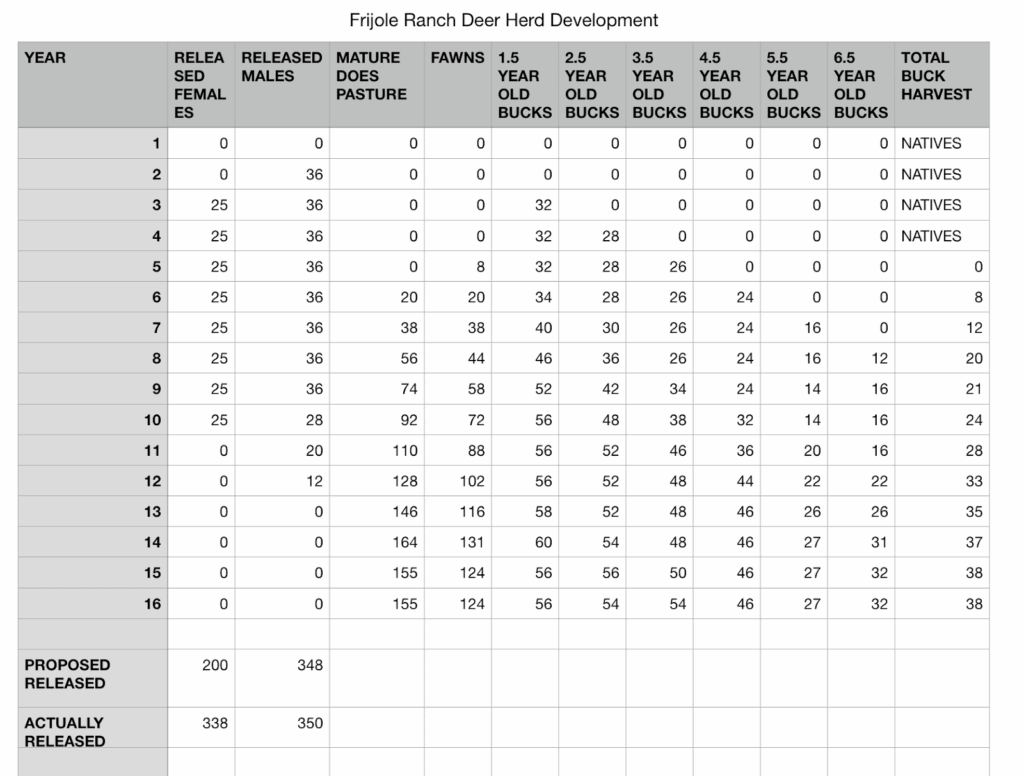
Our end goal was to have a white-tailed deer herd that produced 45 bucks for harvest every year. The preseason herd goal would include 150 mature does, 123 fawns, 56 1.5-year-old bucks, 52 2.5-year-old bucks, 50 3.5-year-old bucks, 48 4.5-year-old bucks, 33 5.5-year-old bucks, 24 6.5-year-old bucks, and 12 7.5-year-old bucks. To produce the quality we desired, the plan included replacing and overwhelming the native genetics using a multiyear release of improved genetics. I have included a chart to show the initial proposed stocking of deer. Due to varying fawn production in the pens, opportunities to sell some offspring and death loss, it took between 12 and 13 years to accomplish our desired goal.
It is worth noting a few findings from this process. My data showed that 66% of the released buck fawns were harvested by a hunter, of which 38% of these scored 170 B&C inches or greater. The percentage of buck fawn classes that score over 170 B&C inches is something that I have been observing for years. I believe that typically 1-1.5% of each buck fawn class will score 170” or greater on low fence, non-fed pastures in South Texas and 4-5% on high-fence, fed pastures in South Texas.
Historically, Texas Parks and Wildlife has had some of the most liberal white-tailed deer management tools available for landowners to utilize on their property. These tools included MLDP permits, TTT permits, DMP permits, breeder permits, release site permits and area technical guidance wildlife biologists. Due to Chronic Wasting Disease concerns, some of the permits have been eliminated and/or severely restricted. The restricting or elimination of these permits could make it even more challenging to develop a trophy white-tailed deer program on an undeveloped ranch.
What is the cost of developing an undeveloped ranch and implementing a trophy white-tailed deer program? This can be difficult to determine because of the number of variables. Building houses, barns, and outdoor structures can cost 15% to 75% more than building in the city due to remoteness, lack of local subcontractors and site preparation. Availability of underground water and the right to pump it vary greatly throughout the state and increasing regulations and more frequent drought conditions make it even more difficult.
The cost to develop a trophy white-tailed deer herd also depends on what ecoregion the property is located in, what the current condition of the existing herd is and, importantly, factoring in the owner’s objectives. When we purchased the Frijole Ranch, which is located in the northern region of the South Texas plains, I determined that the native herd lacked the age class structure in the buck segment and the quality to produce mature deer scoring over 170 B&C inches in a relatively short time frame. Putting resources and 7-10 years into an unknown herd was too risky a chance for me to take. That is why we determined that it would be less risky to replace the existing herd with genetics that had been producing mature bucks over 170 B&C inches for years on our other properties. We used mostly buck and doe fawns because they survived and acclimated to the pasture better. The females would produce longer in the pasture and being raised in the pasture, they acted more like a native herd. All total we released 241 doe fawns, 97 does, 328 buck fawns, and 22 bucks for a total of 688 deer over an 11 year period. To assign a cost to this would be difficult due to the lack of availability of breeder deer. I could make an argument that the deer alone would cost at least $3,000,000.00 if purchased from a deer breeder. What would be even more difficult would be to assign a cost to the time, 15 years, it took to develop the herd.
Currently, the herd has no remaining tagged, released bucks. There are a few remaining tagged, released does in the pasture. The pens were closed, voluntarily, in 2021. We will harvest between 35 and 40 mature bucks this season. Since we stopped releasing deer into the pasture, the percentage of bucks harvested scoring 170 B&C inches or greater has ranged from 26% to 39% of the harvest each year. In the last 13 years, we have harvested 377 bucks, 34 of which have scored 200 B&C inches or better. The program has been successful and we met our goals. The white-tailed deer herd is in great shape.
The Frijole Ranch trophy deer management program is a success story and while it took millions of dollars and over a decade to accomplish, the next steward of the ranch can begin to enjoy it immediately. Our pricing strategy on the Frijole includes the value associated with immediately being able to enjoy an established trophy managed deer herd versus trying to create one from scratch. It has been an incredible adventure using over 40 years of experience in developing the Frijole Ranch. It will be missed.
See the Frijole Ranch listing here.